
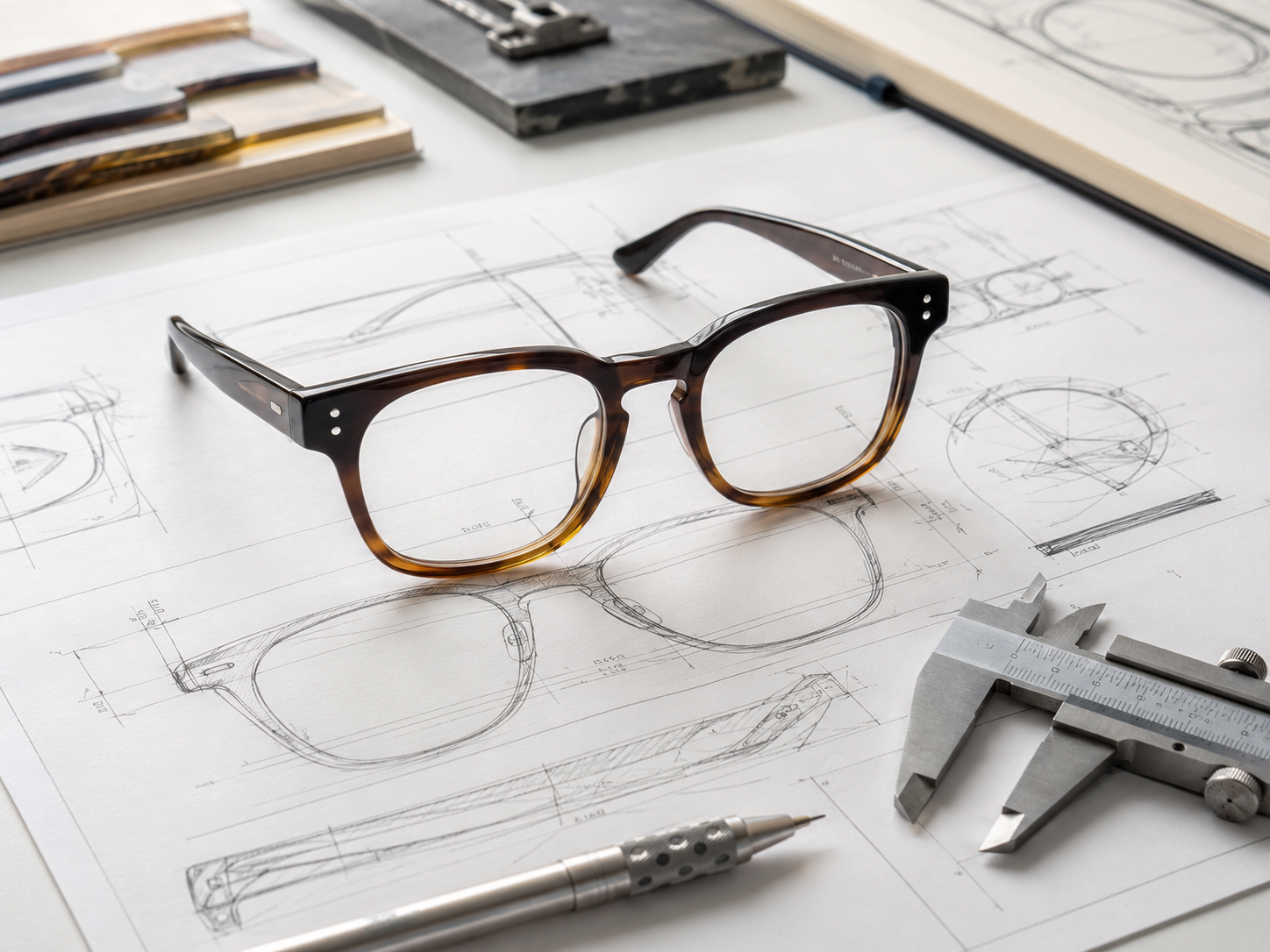
Category: Manufacturing Knowledge

  • From Original Design to Manufacturable Eyewear: Finding the Right Balance

    From Original Design to Manufacturable Eyewear: Finding the Right Balance

    How eyewear brands can protect their original design language while improving frame structure, comfort, durability, and production feasibility.

    Introduction

    When an eyewear brand develops a new collection, an important question often arises:

    Should the brand protect the original design exactly as imagined, or should the design be adjusted to make the product easier and more reliable to manufacture?

    In practice, these two goals should not be treated as opposites.

    Original design gives an eyewear collection its identity, visual language, and market value. Manufacturing and engineering make sure that the design can become a stable, comfortable, and consistently produced product.

    A factory should not simplify a design only because a conventional structure is easier to produce. At the same time, a strong visual concept may still require technical refinement before it can be sampled and manufactured successfully.

    The better approach is to understand and respect the original design first, then improve the structure, materials, and production method without weakening the brand’s core design identity.

    1. Original Design Defines the Brand

    For a new eyewear brand, original design is more than an attractive frame shape. It communicates the brand’s positioning, target customer, aesthetic direction, and long-term identity.

    The most recognizable design elements may include:

    • The overall frame silhouette
    • Lens shape and proportion
    • Bridge design
    • Temple profile
    • Frame thickness
    • Bevels, cut-outs, or layered details
    • Material and color combinations
    • Signature hardware or decorative elements
    • The relationship between the front frame and temples
    • Assembly tolerance

    These details help customers recognize and remember the collection.

    If a factory changes too many of these elements simply to make production easier, the final product may lose the character that made the original concept valuable.

    For this reason, the first step in product development should be to understand the designer’s intention and identify which elements are essential to the brand’s visual language.

    2. A Strong Design Must Also Function as a Product

    A frame can look impressive in a sketch or rendering but still require engineering support before it becomes a practical eyewear product.

    The design must also consider:

    • Frame balance
    • Overall weight
    • Bridge comfort
    • Temple pressure
    • Lens installation
    • Hinge position
    • Material thickness
    • Structural strength
    • Welding or riveting space
    • Polishing accessibility
    • Production consistency

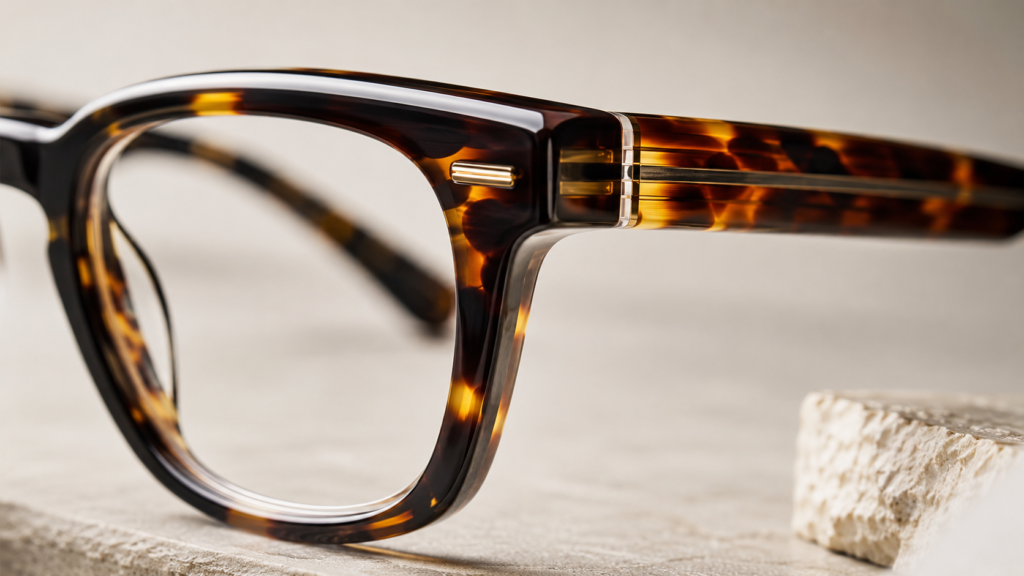
    For example, an extremely thin acetate frame may create an elegant visual effect but may not provide enough strength around the hinge or lens groove.

    A dramatic bevel may look distinctive in a rendering but may change after sanding and polishing.

    A heavy temple design may strengthen the visual identity but create poor weight balance during wear.

    These issues do not necessarily mean the original design is wrong. They mean the design needs technical refinement before it can perform reliably as a finished product.

    3. What Can Happen When Structure Is Ignored?

    When a design is developed without enough consideration for frame structure and production, several problems may appear during sampling or mass production.

    Common examples include:

    • Thin eyewires that deform easily
    • Weak hinge areas
    • Unstable lens installation
    • Sharp lens shapes that are difficult to cut or mount safely
    • Oversized temples that create poor frame balance
    • Bridge shapes that look attractive but do not fit securely
    • Cut-out details that reduce structural strength
    • Metal parts with insufficient welding space
    • Decorative structures that are difficult to assemble consistently
    • Complex surfaces that lose definition during polishing
    • Dimensions that cannot be controlled consistently in production

    These problems can affect comfort, durability, sample approval, lead time, cost, and final product consistency.

    A responsible factory should identify these risks early and explain them clearly rather than waiting until mass production.
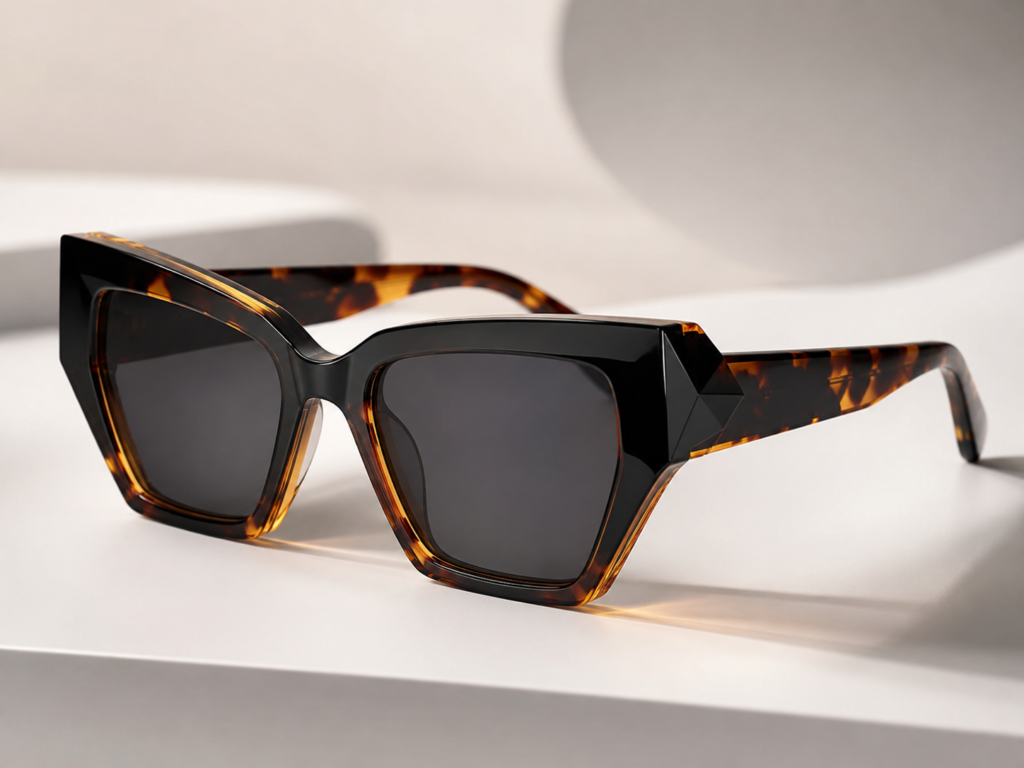
    4. What Can Happen When Production Convenience Comes First?

    Structural improvement is important, but manufacturing convenience should not become the only priority.

    If a factory focuses only on using the easiest production method, it may suggest changes such as:

    • Replacing a unique structure with a standard one
    • Changing distinctive proportions into common dimensions
    • Removing difficult but meaningful design details
    • Replacing custom parts with standard components
    • Simplifying bevels, cut-outs, or layered surfaces
    • Changing the material only because another option is easier to process
    • Reducing finishing requirements
    • Reusing a common frame structure that weakens the collection’s originality

    These changes may reduce development difficulty, but they can also make the final frame look similar to products already on the market.

    A product may become easier to manufacture while losing the reason customers would choose or remember it.

    The factory’s role should therefore be to solve production problems without unnecessarily removing the design’s distinctive character.

    5. The Right Priority: Respect the Design First

    The development process should begin with the original design concept.

    Before suggesting any structural change, the factory should understand:

    • What inspired the design
    • Which details define the brand
    • Who the target customer is
    • What visual effect the designer wants to achieve
    • Which elements are flexible
    • Which elements should not be changed
    • What materials and price level the brand is targeting
    • How the frame should feel when worn

    This information helps the factory distinguish between essential design features and details that can be adjusted without affecting the concept.

    • Protect the original design language.
    • Identify technical and production risks.
    • Recommend only necessary and targeted adjustments.
    • Confirm changes with the brand.
    • Validate the solution through drawings, prototypes, and samples.

    The priority should be:

    This approach allows engineering to support the design rather than replace it.

    6. How Structural Improvements Can Preserve the Original Concept

    Many production issues can be solved through small and precise technical adjustments.

    Examples include:

    • Slightly increasing material thickness in a high-stress area
    • Moving the hinge position by a small distance
    • Adjusting the temple angle to improve fitting
    • Adding hidden internal support
    • Refining the lens groove or mounting method
    • Changing the connection between metal and acetate parts
    • Improving rivet or screw positioning
    • Adjusting bridge dimensions without changing its visual form
    • Modifying an internal surface while preserving the exterior profile
    • Selecting a more suitable production method for the same visual result

    These changes may not be obvious to the customer, but they can significantly improve durability, comfort, assembly, and production consistency.

    The objective is not to redesign the frame. It is to preserve the intended appearance while making the product technically reliable.

    7. Use Technical Drawings and 3D Prototypes Before Formal Sampling

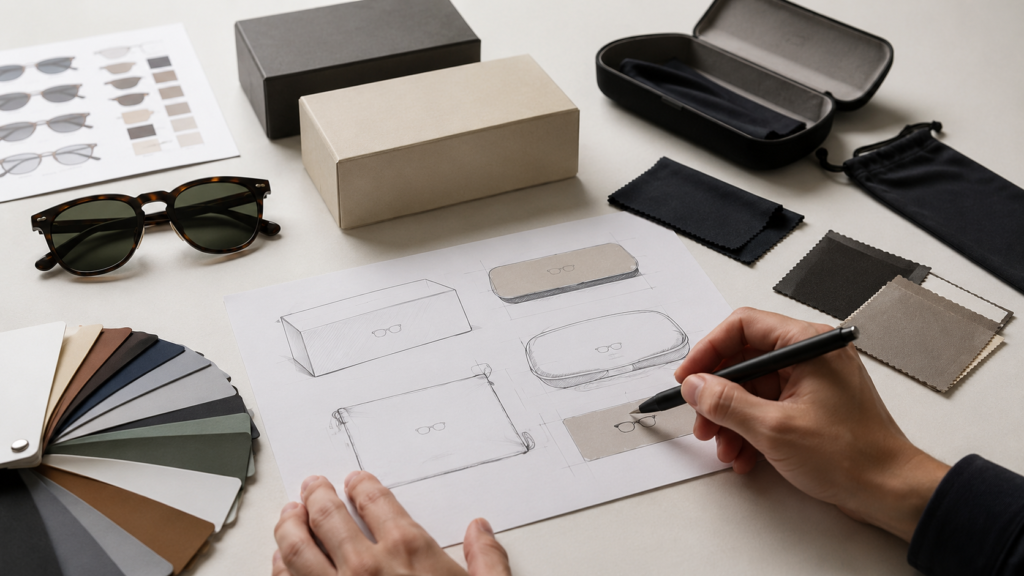
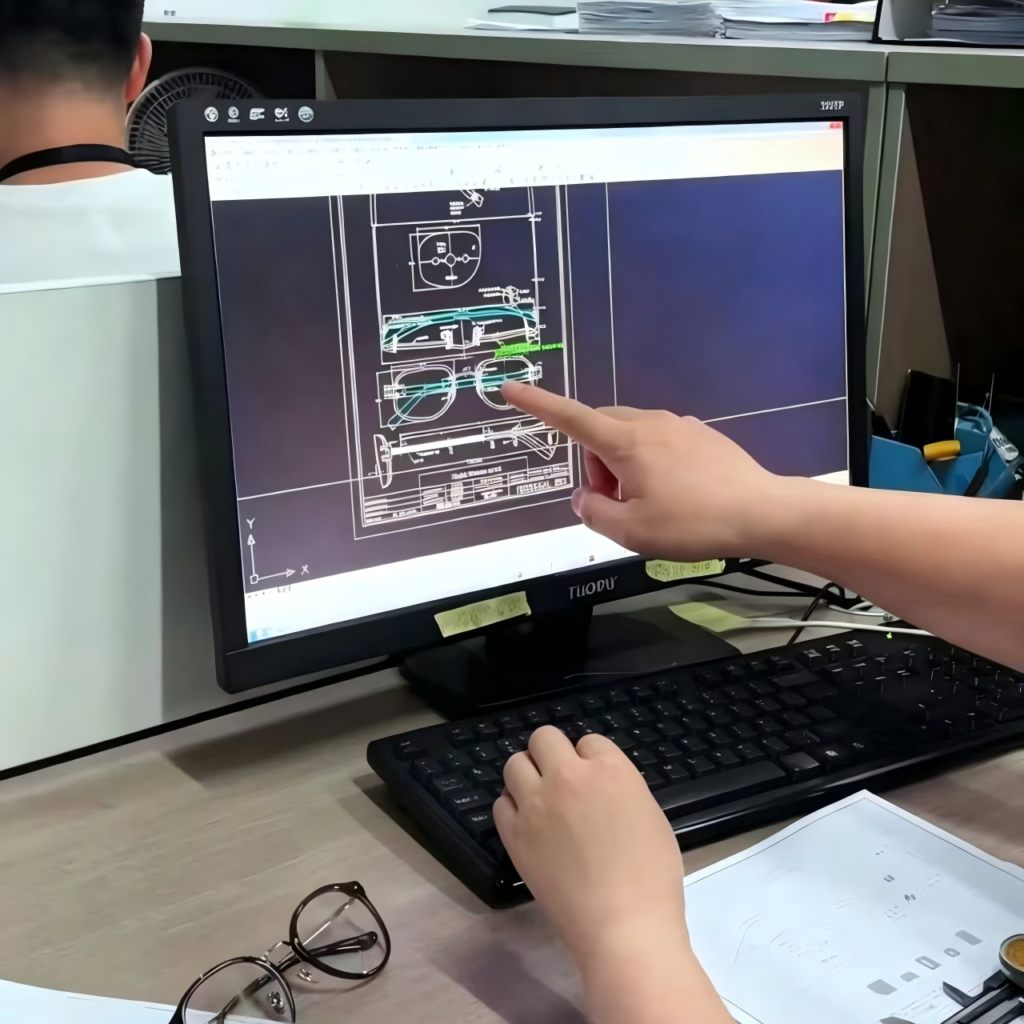
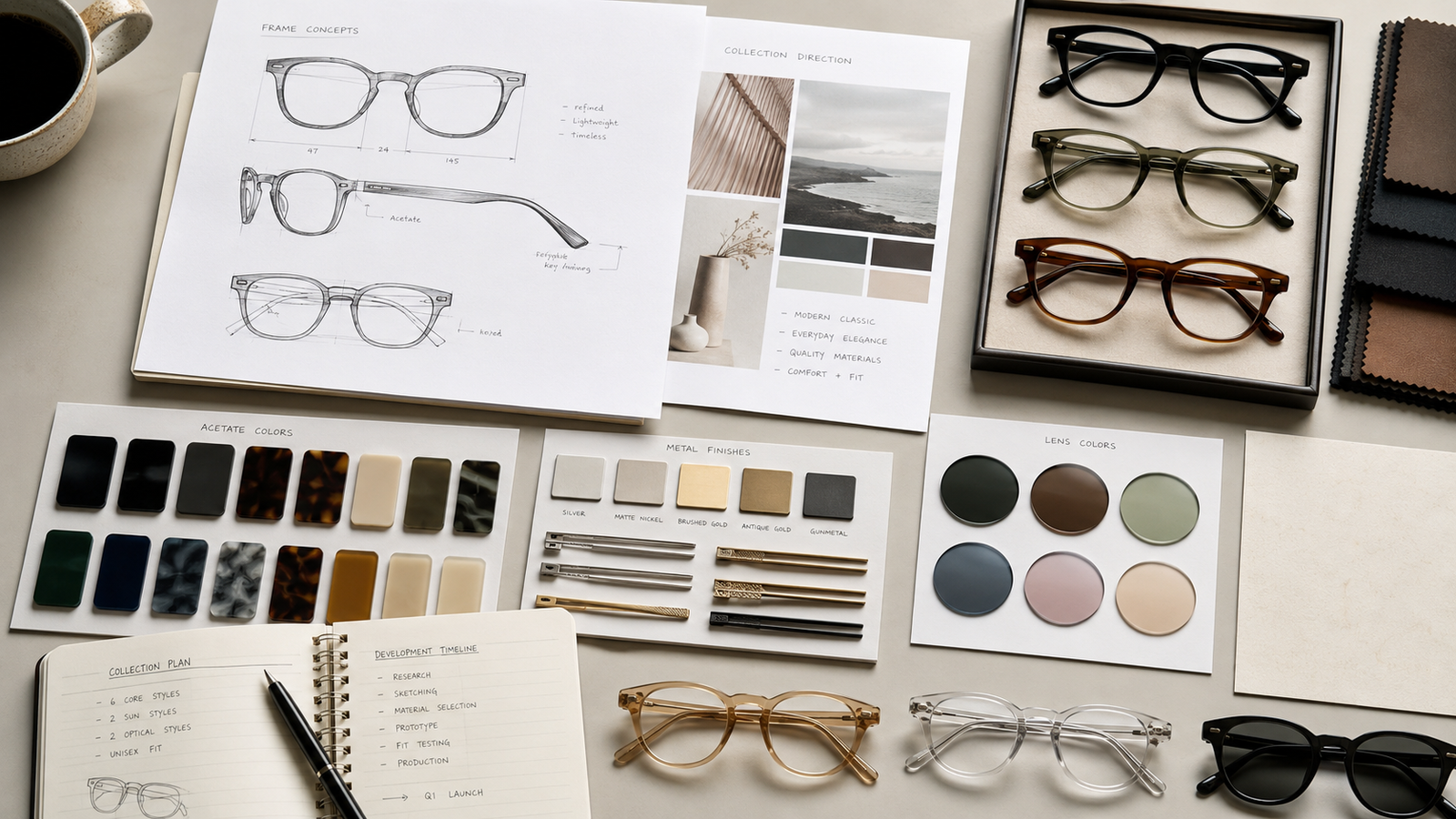
    Technical drawings and 3D development can help brands evaluate a design before investing in a complete material sample.

    A technical review can confirm:

    • Overall dimensions
    • Frame and lens proportions
    • Material thickness
    • Hinge position
    • Bridge structure
    • Temple angle
    • Lens installation
    • Component connections
    • Potential stress points

    A 3D prototype can also help evaluate the overall shape, scale, structure, and fitting direction.

    Depending on the frame structure and project requirements, a 3D sample may be prepared in approximately one week. However, it should be treated as a development tool rather than a final production-quality sample.

    The final material sample is still necessary to confirm:

    • Actual material behavior
    • Polishing effect
    • Color and transparency
    • Metal finishing
    • Hinge movement
    • Lens assembly
    • Weight and balance
    • Wearing comfort
    • Production feasibility

    Using both digital development and physical sampling can reduce unnecessary revisions later.
    8. When Should a Brand Accept Structural Changes?

    A brand should seriously consider technical adjustments when the original design may cause:

    • Safety concerns
    • Frequent breakage or deformation
    • Unstable lens installation
    • Poor hinge durability
    • Uncomfortable fitting
    • Excessive weight imbalance
    • Uncontrollable production tolerance
    • Inconsistent mass-production results
    • Material failure
    • Assembly difficulty that affects quality
    • Finishing problems that cannot be controlled reliably

    However, brands should be cautious when a proposed change is based only on factory convenience and significantly alters the product’s identity.

    A useful question is:

    Does this adjustment improve the product while preserving the design concept, or does it simply make the product easier to manufacture?

    A strong development partner should be able to explain the technical reason behind every important adjustment.

    9. Collaboration Creates Better Eyewear Products

    The strongest eyewear products are rarely created by design or manufacturing alone.

    They are usually developed through cooperation between:

    • Brand vision
    • Design creativity
    • Technical engineering
    • Material knowledge
    • Sampling experience
    • Production planning
    • Quality control

    The designer understands the intended identity and customer experience.

    The factory understands materials, structure, processing limits, assembly, and production consistency.

    When both sides communicate clearly, the result can preserve originality while achieving better comfort, stability, and manufacturability.

    This collaboration is especially important for independent eyewear brands, where product details often carry a larger part of the brand story.
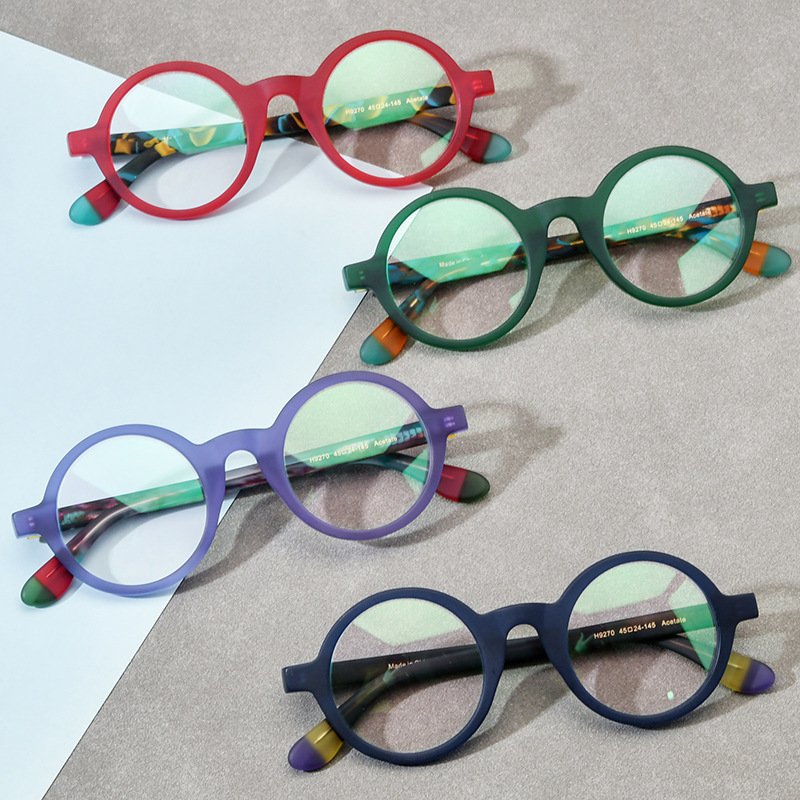
    10. Cenming Eyewear’s Development Approach

    At Cenming Eyewear, our first priority is to understand and respect the original design concept.

    We review the frame’s visual language, target customer, material direction, functional requirements, and key design details before making technical recommendations.

    We then evaluate areas such as:

    • Frame structure
    • Material thickness
    • Fitting and balance
    • Hinge and rivet positioning
    • Lens installation
    • Acetate and metal connections
    • Welding or assembly requirements
    • Polishing and surface finishing
    • Production tolerance
    • Mass-production consistency

    When an adjustment is necessary, our goal is to make it as focused and minimal as possible.

    We do not believe that a design should be simplified until it loses its identity. Our role is to help brands protect their original concept while improving structural stability, comfort, durability, and production feasibility.

    Through technical review, sample development, 3D prototyping, material testing, and production evaluation, we help brands move from an original design idea to a reliable finished eyewear product.

    Conclusion

    Original design and manufacturability should not compete with each other.

    Original design should lead the project because it defines the product’s identity and brand value. Engineering and manufacturing should then support that design by making it stable, comfortable, durable, and suitable for consistent production.

    The best result is not a design that remains completely unchanged despite technical problems, nor a product that is easy to manufacture but no longer distinctive.

    The best result is an eyewear product that preserves the original idea while benefiting from thoughtful structural improvement and experienced manufacturing support.

    For eyewear brands, the value of a professional factory is not simply producing what is drawn. It is helping the design become a better and more reliable product without weakening the creative vision behind it.


    FAQ

    Should eyewear brands prioritize original design or manufacturability?

    Original design should define the product’s identity, while manufacturability ensures that the frame can be produced reliably, comfortably, and consistently. The best approach is to protect the core design concept while making necessary structural improvements.

    Can a factory adjust an eyewear design without changing its identity?

    Yes. Targeted adjustments to material thickness, hinge position, internal support, fitting, or assembly structure can improve performance without changing the main visual language.

    Which parts of an eyewear design commonly need technical adjustment?

    Common areas include frame thickness, bridge structure, hinge position, temple balance, lens mounting, material selection, welding points, and fitting dimensions.

    Does a complex eyewear design always cost more to produce?

    Not always. However, complex structures may require additional tooling, technical development, manual processing, sample revisions, or tighter quality control, which can increase cost and lead time.

    Can a 3D prototype replace a formal eyewear sample?

    No. A 3D prototype is useful for checking shape, scale, structure, and proportions, but a formal material sample is still needed to confirm finishing, assembly, comfort, durability, and production quality.

    How does Cenming Eyewear support original eyewear designs?

    Cenming Eyewear first evaluates the brand’s original design intent, then provides technical support on structure, materials, fitting, production methods, 3D prototyping, sampling, and manufacturing feasibility.
  • OEM vs ODM Eyewear Manufacturing: Which Is Better for Your Brand?

    OEM vs ODM Eyewear Manufacturing: Which Is Better for Your Brand?

    Understand the key differences between OEM and ODM eyewear manufacturing and learn which model better matches your brand’s design readiness, development needs, and product goals.

    Introduction

    When eyewear brands begin looking for a manufacturing partner, two terms often appear: OEM and ODM. Both are common cooperation models in eyewear manufacturing, but the distinction between them is not always explained consistently.

    In practice, the difference is not simply that OEM is “fully custom” while ODM uses “existing designs.” Both models may involve design development, engineering, sampling, revisions, material selection, and production planning.

    The key difference is usually the starting point of the project and the level of development support required from the factory.

    Understanding this helps brands communicate more clearly with manufacturers and choose a cooperation model that matches their current design preparation, target market, budget, and product strategy.

    1. What OEM Eyewear Manufacturing Means

    OEM stands for Original Equipment Manufacturing.

    In eyewear manufacturing, OEM usually means that the brand provides a relatively clear product direction, such as a design, technical drawing, reference frame, sample, product specification, or detailed modification requirements.

    The factory then supports the technical development, material selection, structural adjustment, sample making, and production according to the brand’s direction.

    An OEM project may start from:

    • An original frame design created by the brand
    • A technical drawing or 3D file
    • A physical reference sample
    • An existing frame that requires structural or visual modification
    • Clear requirements for size, materials, lenses, hinges, colors, logos, or packaging

    OEM does not necessarily mean that every part of the product was originally designed by the brand. In many projects, the brand provides the main direction while the factory helps refine the frame structure and prepare it for production.

    OEM is generally suitable for brands that already know what they want to develop and need a manufacturer to turn that direction into a reliable, manufacturable eyewear product.

    2. What ODM Eyewear Manufacturing Means

    ODM stands for Original Design Manufacturing.

    In an ODM eyewear project, the brand usually provides a broader concept rather than a fully developed frame design. This may include the target customer, market positioning, visual style, product category, price range, material preference, or collection concept.

    The factory then helps turn these ideas into a complete and manufacturable eyewear design.

    ODM development may include:

    • Defining the frame shape and proportions
    • Developing the frame structure
    • Selecting suitable materials
    • Recommending colors and lens options
    • Adjusting fitting and dimensions
    • Developing technical details
    • Producing samples and making revisions
    • Preparing the design for production

    ODM does not always mean selecting a ready-made factory design. Depending on the project, it may involve developing a new concept from the early design stage or adapting a factory-developed direction to suit the brand.

    It is more suitable for brands that have a clear business or style concept but need professional support to develop that concept into a finished eyewear product.

    3. The Main Difference Between OEM and ODM

    The main difference is the project’s starting point.

    With OEM, the brand normally begins with a clearer product direction, reference style, design, or technical requirement. The factory focuses on engineering, sampling, adjustment, and production.

    With ODM, the brand normally begins with a concept, target market, style direction, or product requirement. The factory takes a greater role in developing the product design and preparing it for manufacturing.

    A simplified comparison is:

    Project areaOEMODM
    Starting pointClear design, reference frame, specifications, or modification requirementsBrand concept, target customer, style direction, or product requirements
    Factory roleEngineering, technical adjustment, sampling, and productionEngineering, technical adjustment, sampling, and production
    Brand preparationMore developed product directionBroader concept or collection idea
    SamplingUsually requiredUsually required
    RevisionsDepend on the projectDepend on the project
    Cost and timelineDepend on complexityDepend on complexity

    Neither model is automatically better, faster, or cheaper. The result depends on the actual project requirements.

    4. When OEM May Be the Better Choice

    OEM may be more suitable when a brand already has:

    • Original sketches or technical drawings
    • A physical reference sample
    • Clear frame dimensions and fitting requirements
    • Specific material or lens requirements
    • Defined hinge, temple, bridge, or structural details
    • Clear logo and packaging standards
    • An existing frame that needs modification

    In this type of project, the factory’s role is to evaluate whether the design can be manufactured efficiently and reliably.

    The factory may still recommend adjustments to improve fitting, durability, material use, polishing, assembly, or production consistency. Therefore, OEM is not simply “copying a drawing.” Technical development and sample evaluation are still important parts of the process.

    5. When ODM May Be the Better Choice

    ODM may be more suitable when a brand has:

    • A brand concept but no complete frame design
    • A target customer and market position
    • A general visual direction
    • Reference images but no technical drawings
    • A collection theme or product category
    • A target price range
    • A need for factory-supported design development

    For example, a brand may want a lightweight acetate sunglasses collection for European lifestyle customers but may not yet know the exact frame shape, dimensions, hinge structure, or material thickness.

    In this case, the factory can help develop the concept into a practical eyewear design.

    ODM still requires product development. The project may involve design proposals, structural evaluation, material selection, sample making, fitting adjustments, and several rounds of revision.

    It should not automatically be described as a faster or lower-cost option.

    6. Cost, Timeline, and Development Complexity

    The cost and timeline of an eyewear project depend more on the product itself than on whether it is labeled OEM or ODM.

    Important factors include:

    • Frame structure and design complexity
    • Acetate, metal, titanium, TR, or mixed-material construction
    • New mold or tooling requirements
    • Special hinges or custom components
    • Material availability
    • Lens specifications
    • Logo and finishing requirements
    • Number of samples and revisions
    • Testing requirements
    • Packaging development
    • Order quantity

    A relatively simple OEM modification based on a proven frame structure may be faster than a new ODM concept that requires full design development.

    At the same time, an OEM project with complex structural requirements, custom molds, or several rounds of revision may take longer than an ODM project based on a mature technical direction.

    Therefore, brands should request a project-specific evaluation instead of assuming that one model is always faster or more cost-effective.

    7.Design Ownership and Exclusivity

    Design ownership should not be assumed only from the terms OEM or ODM.

    A brand may provide its own original design in an OEM project, but the factory may still contribute structural engineering, technical drawings, molds, or manufacturing solutions.

    In an ODM project, the factory may develop part or all of the product design based on the brand’s concept.

    Before development begins, both parties should clarify:

    • Who owns the original design
    • Who owns the technical drawings
    • Who owns the molds or tooling
    • Whether the design is exclusive
    • Whether the factory may offer a similar design to other clients
    • Whether exclusivity applies to a market, country, or period
    • How design changes and development fees are handled

    These points should be confirmed clearly during project communication or through a written agreement.

    8.Where Private Label Fits In

    Private label and white label eyewear are sometimes confused with ODM, but they are not exactly the same.

    Private label eyewear usually starts from an existing product or mature frame structure. The brand then customizes selected elements such as:

    • Logo
    • Frame color
    • Lens color
    • Packaging
    • Accessories
    • Product selection

    This model is generally more suitable for brands that want to launch products without developing a completely new frame structure.

    OEM and ODM normally involve more product development than standard private label projects, although the boundaries may overlap depending on the factory and project.

    9.Which Model Is Better for a New Eyewear Brand?

    Neither OEM nor ODM is automatically better for every new brand.

    OEM may be suitable when the brand already has a clear design, reference style, or detailed product direction.

    ODM may be suitable when the brand has a concept, target market, or visual direction but needs support developing a complete eyewear product.

    Some new brands may also begin with private label products before moving into OEM or ODM development.

    The better choice depends on:

    • How developed the product idea is
    • How much design support the brand needs
    • Whether exclusivity is required
    • The target budget
    • The desired launch timeline
    • Product complexity
    • Long-term brand strategy

    The best manufacturing model is the one that matches the brand’s actual preparation and project requirements.

    Conclusion

    OEM and ODM are both valuable eyewear manufacturing models, but they support brands at different stages of product development.

    OEM generally begins with a clearer design, reference frame, specification, or modification requirement from the brand. The factory then supports technical development, sampling, adjustment, and production.

    ODM generally begins with a concept, target customer, or style direction. The factory plays a larger role in developing the concept into a complete and manufacturable eyewear design.

    Both models may require development, sampling, revisions, tooling, and quality evaluation. Cost and lead time should be assessed according to the actual frame design and production requirements rather than the manufacturing label alone.

    Cenming Eyewear supports OEM eyewear manufacturing, ODM eyewear development, white label projects, sample development, custom sunglasses, optical frames, and flexible production for new and growing eyewear brands.

    FAQ

    What does OEM eyewear manufacturing mean?

    OEM eyewear manufacturing usually means that the brand provides a design, reference style, product specifications, or clear modification requirements, and the factory supports technical development, sampling, adjustment, and production according to the brand’s direction.

    What does ODM eyewear manufacturing mean?

    ODM eyewear manufacturing means that the brand provides a concept, target customer, style direction, or product requirements, and the factory helps develop these ideas into a complete and manufacturable eyewear design.

    Is OEM or ODM better for a new eyewear brand?

    It depends on how developed the brand’s product idea is. OEM is more suitable when the brand has a clear design, reference style, or technical requirements. ODM is more suitable when the brand has a concept and needs support turning it into a complete eyewear design.

    Is ODM eyewear manufacturing always faster than OEM?

    No. The development time depends on the frame structure, materials, tooling, sample revisions, and technical requirements. A new ODM design may require more development time than a straightforward OEM modification.

    Can an OEM project be based on a reference frame?

    Yes. An OEM project may start from an original design, technical drawing, reference sample, or existing frame that the brand wants to modify according to its requirements.

    Who owns the design in an OEM or ODM project?

    Design ownership depends on the project agreement. Brands and factories should clarify ownership of designs, technical drawings, molds, and exclusivity before development begins.