
Understand the key differences between OEM and ODM eyewear manufacturing and learn which model better matches your brand’s design readiness, development needs, and product goals.
Introduction
When eyewear brands begin looking for a manufacturing partner, two terms often appear: OEM and ODM. Both are common cooperation models in eyewear manufacturing, but the distinction between them is not always explained consistently.
In practice, the difference is not simply that OEM is “fully custom” while ODM uses “existing designs.” Both models may involve design development, engineering, sampling, revisions, material selection, and production planning.
The key difference is usually the starting point of the project and the level of development support required from the factory.
Understanding this helps brands communicate more clearly with manufacturers and choose a cooperation model that matches their current design preparation, target market, budget, and product strategy.
1. What OEM Eyewear Manufacturing Means
OEM stands for Original Equipment Manufacturing.
In eyewear manufacturing, OEM usually means that the brand provides a relatively clear product direction, such as a design, technical drawing, reference frame, sample, product specification, or detailed modification requirements.
The factory then supports the technical development, material selection, structural adjustment, sample making, and production according to the brand’s direction.
An OEM project may start from:
- An original frame design created by the brand
- A technical drawing or 3D file
- A physical reference sample
- An existing frame that requires structural or visual modification
- Clear requirements for size, materials, lenses, hinges, colors, logos, or packaging
OEM does not necessarily mean that every part of the product was originally designed by the brand. In many projects, the brand provides the main direction while the factory helps refine the frame structure and prepare it for production.
OEM is generally suitable for brands that already know what they want to develop and need a manufacturer to turn that direction into a reliable, manufacturable eyewear product.
2. What ODM Eyewear Manufacturing Means
ODM stands for Original Design Manufacturing.
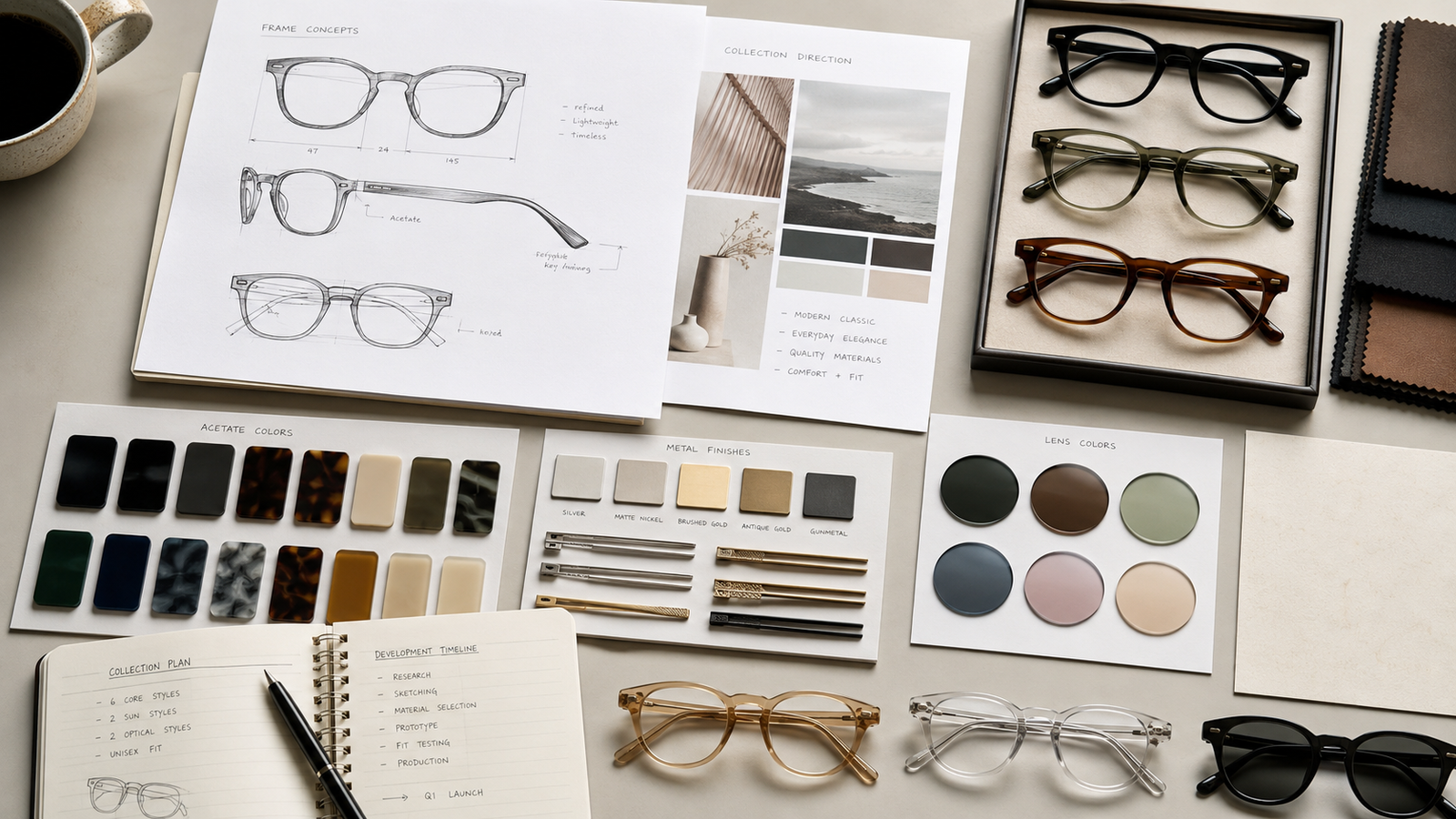
In an ODM eyewear project, the brand usually provides a broader concept rather than a fully developed frame design. This may include the target customer, market positioning, visual style, product category, price range, material preference, or collection concept.
The factory then helps turn these ideas into a complete and manufacturable eyewear design.
ODM development may include:
- Defining the frame shape and proportions
- Developing the frame structure
- Selecting suitable materials
- Recommending colors and lens options
- Adjusting fitting and dimensions
- Developing technical details
- Producing samples and making revisions
- Preparing the design for production
ODM does not always mean selecting a ready-made factory design. Depending on the project, it may involve developing a new concept from the early design stage or adapting a factory-developed direction to suit the brand.
It is more suitable for brands that have a clear business or style concept but need professional support to develop that concept into a finished eyewear product.
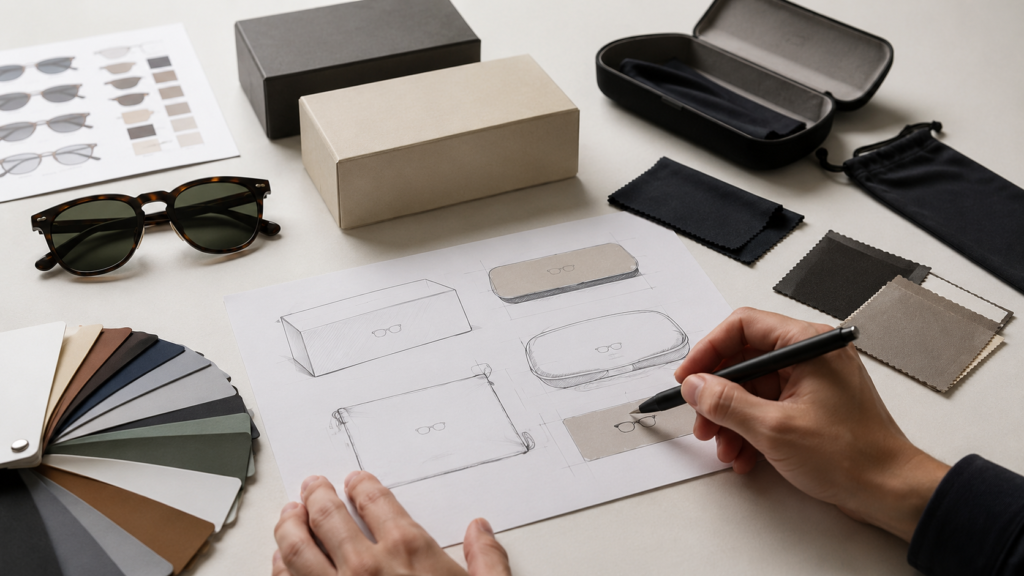
3. The Main Difference Between OEM and ODM
The main difference is the project’s starting point.
With OEM, the brand normally begins with a clearer product direction, reference style, design, or technical requirement. The factory focuses on engineering, sampling, adjustment, and production.
With ODM, the brand normally begins with a concept, target market, style direction, or product requirement. The factory takes a greater role in developing the product design and preparing it for manufacturing.
A simplified comparison is:
| Project area | OEM | ODM |
|---|---|---|
| Starting point | Clear design, reference frame, specifications, or modification requirements | Brand concept, target customer, style direction, or product requirements |
| Factory role | Engineering, technical adjustment, sampling, and production | Engineering, technical adjustment, sampling, and production |
| Brand preparation | More developed product direction | Broader concept or collection idea |
| Sampling | Usually required | Usually required |
| Revisions | Depend on the project | Depend on the project |
| Cost and timeline | Depend on complexity | Depend on complexity |
Neither model is automatically better, faster, or cheaper. The result depends on the actual project requirements.
4. When OEM May Be the Better Choice
OEM may be more suitable when a brand already has:
- Original sketches or technical drawings
- A physical reference sample
- Clear frame dimensions and fitting requirements
- Specific material or lens requirements
- Defined hinge, temple, bridge, or structural details
- Clear logo and packaging standards
- An existing frame that needs modification
In this type of project, the factory’s role is to evaluate whether the design can be manufactured efficiently and reliably.
The factory may still recommend adjustments to improve fitting, durability, material use, polishing, assembly, or production consistency. Therefore, OEM is not simply “copying a drawing.” Technical development and sample evaluation are still important parts of the process.
5. When ODM May Be the Better Choice
ODM may be more suitable when a brand has:
- A brand concept but no complete frame design
- A target customer and market position
- A general visual direction
- Reference images but no technical drawings
- A collection theme or product category
- A target price range
- A need for factory-supported design development
For example, a brand may want a lightweight acetate sunglasses collection for European lifestyle customers but may not yet know the exact frame shape, dimensions, hinge structure, or material thickness.
In this case, the factory can help develop the concept into a practical eyewear design.
ODM still requires product development. The project may involve design proposals, structural evaluation, material selection, sample making, fitting adjustments, and several rounds of revision.
It should not automatically be described as a faster or lower-cost option.
6. Cost, Timeline, and Development Complexity
The cost and timeline of an eyewear project depend more on the product itself than on whether it is labeled OEM or ODM.
Important factors include:
- Frame structure and design complexity
- Acetate, metal, titanium, TR, or mixed-material construction
- New mold or tooling requirements
- Special hinges or custom components
- Material availability
- Lens specifications
- Logo and finishing requirements
- Number of samples and revisions
- Testing requirements
- Packaging development
- Order quantity
A relatively simple OEM modification based on a proven frame structure may be faster than a new ODM concept that requires full design development.
At the same time, an OEM project with complex structural requirements, custom molds, or several rounds of revision may take longer than an ODM project based on a mature technical direction.
Therefore, brands should request a project-specific evaluation instead of assuming that one model is always faster or more cost-effective.
7.Design Ownership and Exclusivity
Design ownership should not be assumed only from the terms OEM or ODM.
A brand may provide its own original design in an OEM project, but the factory may still contribute structural engineering, technical drawings, molds, or manufacturing solutions.
In an ODM project, the factory may develop part or all of the product design based on the brand’s concept.
Before development begins, both parties should clarify:
- Who owns the original design
- Who owns the technical drawings
- Who owns the molds or tooling
- Whether the design is exclusive
- Whether the factory may offer a similar design to other clients
- Whether exclusivity applies to a market, country, or period
- How design changes and development fees are handled
These points should be confirmed clearly during project communication or through a written agreement.
8.Where Private Label Fits In
Private label and white label eyewear are sometimes confused with ODM, but they are not exactly the same.
Private label eyewear usually starts from an existing product or mature frame structure. The brand then customizes selected elements such as:
- Logo
- Frame color
- Lens color
- Packaging
- Accessories
- Product selection
This model is generally more suitable for brands that want to launch products without developing a completely new frame structure.
OEM and ODM normally involve more product development than standard private label projects, although the boundaries may overlap depending on the factory and project.
9.Which Model Is Better for a New Eyewear Brand?
Neither OEM nor ODM is automatically better for every new brand.
OEM may be suitable when the brand already has a clear design, reference style, or detailed product direction.
ODM may be suitable when the brand has a concept, target market, or visual direction but needs support developing a complete eyewear product.
Some new brands may also begin with private label products before moving into OEM or ODM development.
The better choice depends on:
- How developed the product idea is
- How much design support the brand needs
- Whether exclusivity is required
- The target budget
- The desired launch timeline
- Product complexity
- Long-term brand strategy
The best manufacturing model is the one that matches the brand’s actual preparation and project requirements.
Conclusion
OEM and ODM are both valuable eyewear manufacturing models, but they support brands at different stages of product development.
OEM generally begins with a clearer design, reference frame, specification, or modification requirement from the brand. The factory then supports technical development, sampling, adjustment, and production.
ODM generally begins with a concept, target customer, or style direction. The factory plays a larger role in developing the concept into a complete and manufacturable eyewear design.
Both models may require development, sampling, revisions, tooling, and quality evaluation. Cost and lead time should be assessed according to the actual frame design and production requirements rather than the manufacturing label alone.
Cenming Eyewear supports OEM eyewear manufacturing, ODM eyewear development, white label projects, sample development, custom sunglasses, optical frames, and flexible production for new and growing eyewear brands.
FAQ
What does OEM eyewear manufacturing mean?
OEM eyewear manufacturing usually means that the brand provides a design, reference style, product specifications, or clear modification requirements, and the factory supports technical development, sampling, adjustment, and production according to the brand’s direction.
What does ODM eyewear manufacturing mean?
ODM eyewear manufacturing means that the brand provides a concept, target customer, style direction, or product requirements, and the factory helps develop these ideas into a complete and manufacturable eyewear design.
Is OEM or ODM better for a new eyewear brand?
It depends on how developed the brand’s product idea is. OEM is more suitable when the brand has a clear design, reference style, or technical requirements. ODM is more suitable when the brand has a concept and needs support turning it into a complete eyewear design.
Is ODM eyewear manufacturing always faster than OEM?
No. The development time depends on the frame structure, materials, tooling, sample revisions, and technical requirements. A new ODM design may require more development time than a straightforward OEM modification.
Can an OEM project be based on a reference frame?
Yes. An OEM project may start from an original design, technical drawing, reference sample, or existing frame that the brand wants to modify according to its requirements.
Who owns the design in an OEM or ODM project?
Design ownership depends on the project agreement. Brands and factories should clarify ownership of designs, technical drawings, molds, and exclusivity before development begins.