

How eyewear brands can protect their original design language while improving frame structure, comfort, durability, and production feasibility.
Introduction
When an eyewear brand develops a new collection, an important question often arises:
Should the brand protect the original design exactly as imagined, or should the design be adjusted to make the product easier and more reliable to manufacture?
In practice, these two goals should not be treated as opposites.
Original design gives an eyewear collection its identity, visual language, and market value. Manufacturing and engineering make sure that the design can become a stable, comfortable, and consistently produced product.
A factory should not simplify a design only because a conventional structure is easier to produce. At the same time, a strong visual concept may still require technical refinement before it can be sampled and manufactured successfully.
The better approach is to understand and respect the original design first, then improve the structure, materials, and production method without weakening the brand’s core design identity.
1. Original Design Defines the Brand
For a new eyewear brand, original design is more than an attractive frame shape. It communicates the brand’s positioning, target customer, aesthetic direction, and long-term identity.
The most recognizable design elements may include:
- The overall frame silhouette
- Lens shape and proportion
- Bridge design
- Temple profile
- Frame thickness
- Bevels, cut-outs, or layered details
- Material and color combinations
- Signature hardware or decorative elements
- The relationship between the front frame and temples
- Assembly tolerance
These details help customers recognize and remember the collection.
If a factory changes too many of these elements simply to make production easier, the final product may lose the character that made the original concept valuable.
For this reason, the first step in product development should be to understand the designer’s intention and identify which elements are essential to the brand’s visual language.
2. A Strong Design Must Also Function as a Product
A frame can look impressive in a sketch or rendering but still require engineering support before it becomes a practical eyewear product.
The design must also consider:
- Frame balance
- Overall weight
- Bridge comfort
- Temple pressure
- Lens installation
- Hinge position
- Material thickness
- Structural strength
- Welding or riveting space
- Polishing accessibility
- Production consistency
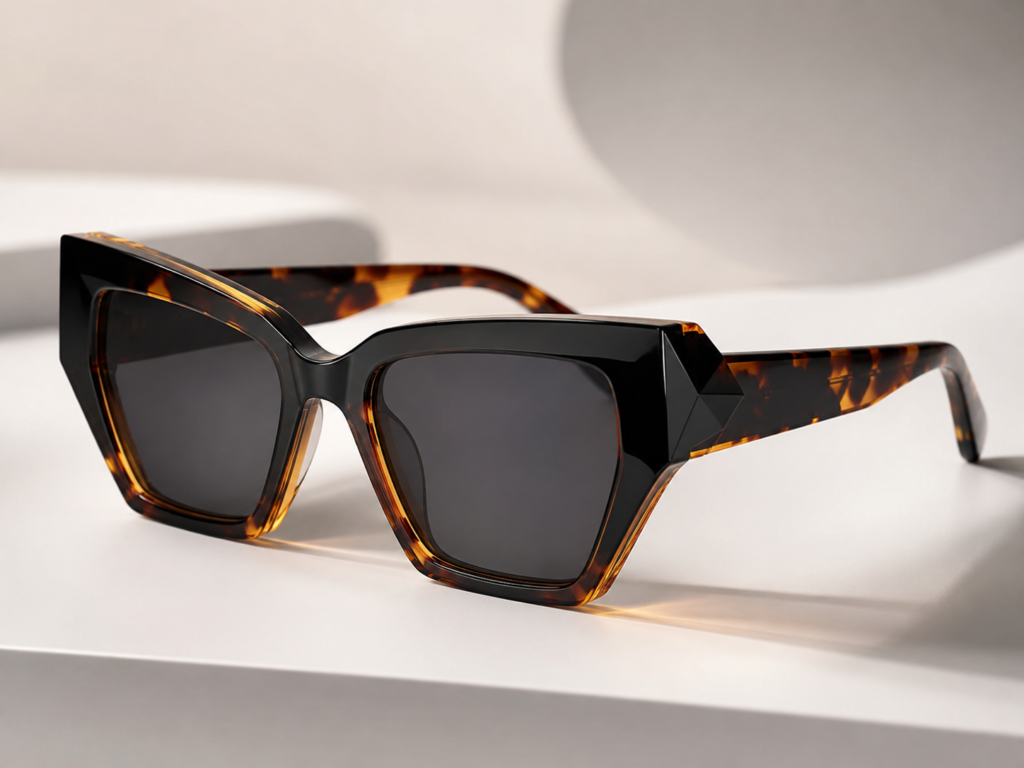
For example, an extremely thin acetate frame may create an elegant visual effect but may not provide enough strength around the hinge or lens groove.
A dramatic bevel may look distinctive in a rendering but may change after sanding and polishing.
A heavy temple design may strengthen the visual identity but create poor weight balance during wear.
These issues do not necessarily mean the original design is wrong. They mean the design needs technical refinement before it can perform reliably as a finished product.
3. What Can Happen When Structure Is Ignored?
When a design is developed without enough consideration for frame structure and production, several problems may appear during sampling or mass production.
Common examples include:
- Thin eyewires that deform easily
- Weak hinge areas
- Unstable lens installation
- Sharp lens shapes that are difficult to cut or mount safely
- Oversized temples that create poor frame balance
- Bridge shapes that look attractive but do not fit securely
- Cut-out details that reduce structural strength
- Metal parts with insufficient welding space
- Decorative structures that are difficult to assemble consistently
- Complex surfaces that lose definition during polishing
- Dimensions that cannot be controlled consistently in production
These problems can affect comfort, durability, sample approval, lead time, cost, and final product consistency.
A responsible factory should identify these risks early and explain them clearly rather than waiting until mass production.
4. What Can Happen When Production Convenience Comes First?
Structural improvement is important, but manufacturing convenience should not become the only priority.
If a factory focuses only on using the easiest production method, it may suggest changes such as:
- Replacing a unique structure with a standard one
- Changing distinctive proportions into common dimensions
- Removing difficult but meaningful design details
- Replacing custom parts with standard components
- Simplifying bevels, cut-outs, or layered surfaces
- Changing the material only because another option is easier to process
- Reducing finishing requirements
- Reusing a common frame structure that weakens the collection’s originality
These changes may reduce development difficulty, but they can also make the final frame look similar to products already on the market.
A product may become easier to manufacture while losing the reason customers would choose or remember it.
The factory’s role should therefore be to solve production problems without unnecessarily removing the design’s distinctive character.
5. The Right Priority: Respect the Design First
The development process should begin with the original design concept.
Before suggesting any structural change, the factory should understand:
- What inspired the design
- Which details define the brand
- Who the target customer is
- What visual effect the designer wants to achieve
- Which elements are flexible
- Which elements should not be changed
- What materials and price level the brand is targeting
- How the frame should feel when worn
This information helps the factory distinguish between essential design features and details that can be adjusted without affecting the concept.
- Protect the original design language.
- Identify technical and production risks.
- Recommend only necessary and targeted adjustments.
- Confirm changes with the brand.
- Validate the solution through drawings, prototypes, and samples.
The priority should be:
This approach allows engineering to support the design rather than replace it.
6. How Structural Improvements Can Preserve the Original Concept
Many production issues can be solved through small and precise technical adjustments.
Examples include:
- Slightly increasing material thickness in a high-stress area
- Moving the hinge position by a small distance
- Adjusting the temple angle to improve fitting
- Adding hidden internal support
- Refining the lens groove or mounting method
- Changing the connection between metal and acetate parts
- Improving rivet or screw positioning
- Adjusting bridge dimensions without changing its visual form
- Modifying an internal surface while preserving the exterior profile
- Selecting a more suitable production method for the same visual result
These changes may not be obvious to the customer, but they can significantly improve durability, comfort, assembly, and production consistency.
The objective is not to redesign the frame. It is to preserve the intended appearance while making the product technically reliable.
7. Use Technical Drawings and 3D Prototypes Before Formal Sampling
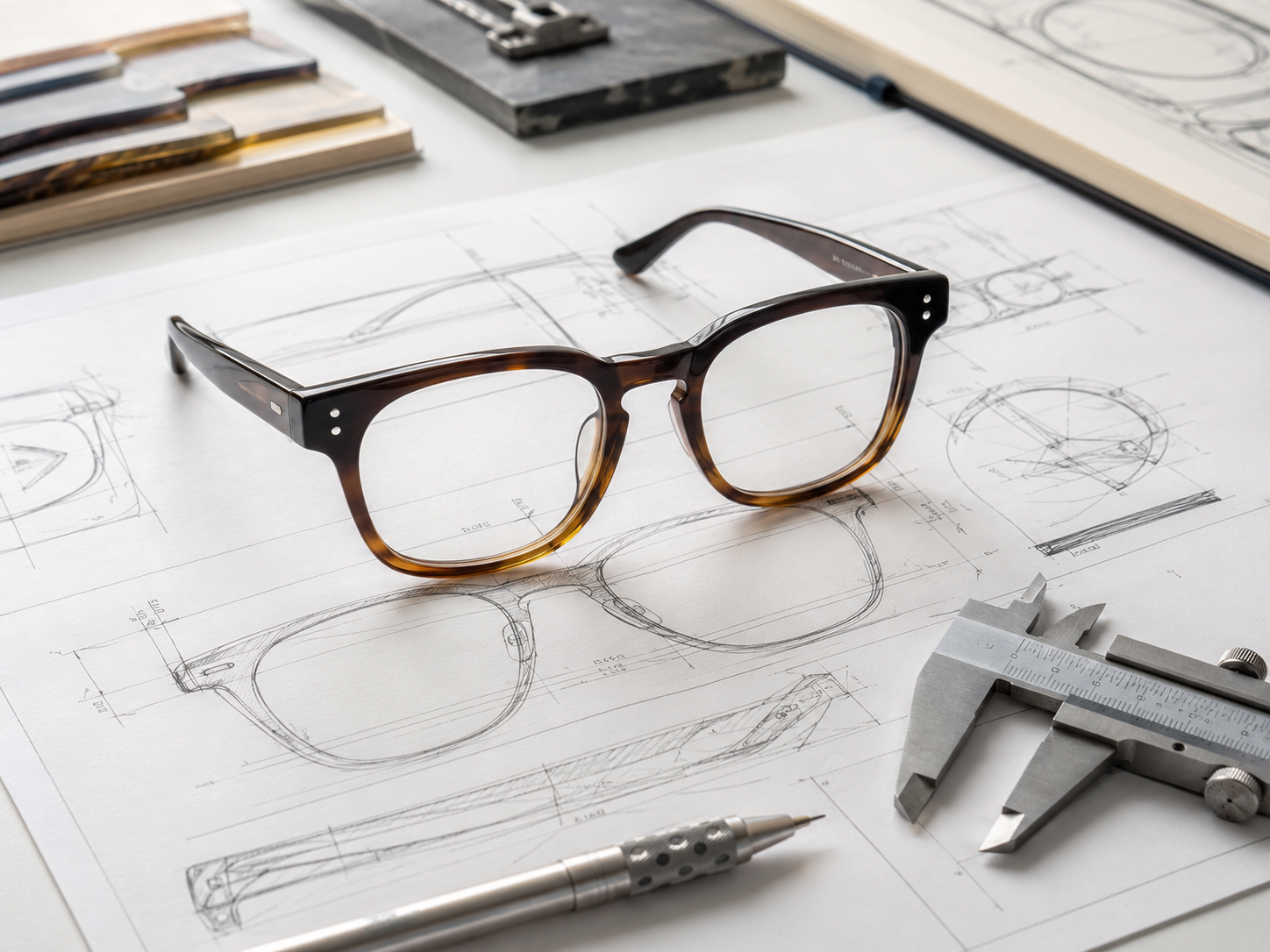
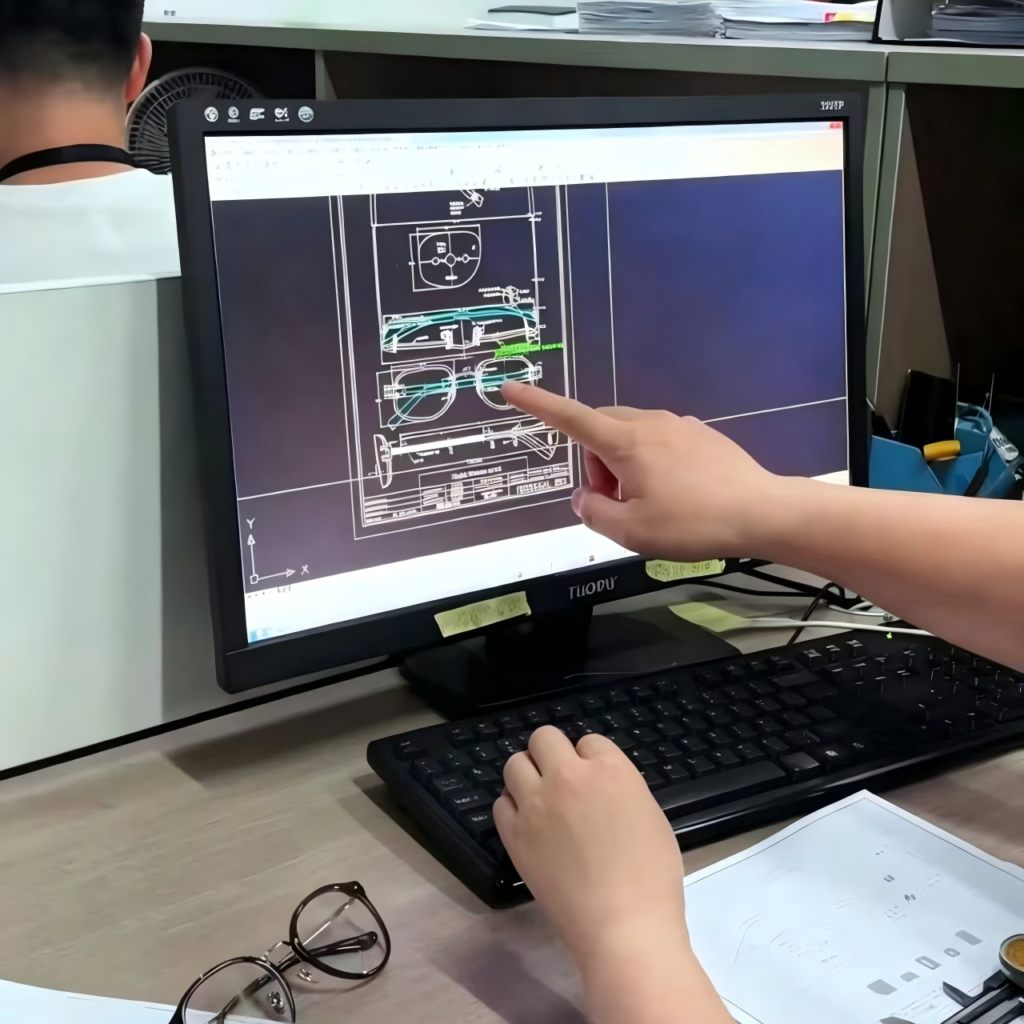
Technical drawings and 3D development can help brands evaluate a design before investing in a complete material sample.
A technical review can confirm:
- Overall dimensions
- Frame and lens proportions
- Material thickness
- Hinge position
- Bridge structure
- Temple angle
- Lens installation
- Component connections
- Potential stress points
A 3D prototype can also help evaluate the overall shape, scale, structure, and fitting direction.
Depending on the frame structure and project requirements, a 3D sample may be prepared in approximately one week. However, it should be treated as a development tool rather than a final production-quality sample.
The final material sample is still necessary to confirm:
- Actual material behavior
- Polishing effect
- Color and transparency
- Metal finishing
- Hinge movement
- Lens assembly
- Weight and balance
- Wearing comfort
- Production feasibility
Using both digital development and physical sampling can reduce unnecessary revisions later.
8. When Should a Brand Accept Structural Changes?
A brand should seriously consider technical adjustments when the original design may cause:
- Safety concerns
- Frequent breakage or deformation
- Unstable lens installation
- Poor hinge durability
- Uncomfortable fitting
- Excessive weight imbalance
- Uncontrollable production tolerance
- Inconsistent mass-production results
- Material failure
- Assembly difficulty that affects quality
- Finishing problems that cannot be controlled reliably
However, brands should be cautious when a proposed change is based only on factory convenience and significantly alters the product’s identity.
A useful question is:
Does this adjustment improve the product while preserving the design concept, or does it simply make the product easier to manufacture?
A strong development partner should be able to explain the technical reason behind every important adjustment.
9. Collaboration Creates Better Eyewear Products
The strongest eyewear products are rarely created by design or manufacturing alone.
They are usually developed through cooperation between:
- Brand vision
- Design creativity
- Technical engineering
- Material knowledge
- Sampling experience
- Production planning
- Quality control
The designer understands the intended identity and customer experience.
The factory understands materials, structure, processing limits, assembly, and production consistency.
When both sides communicate clearly, the result can preserve originality while achieving better comfort, stability, and manufacturability.
This collaboration is especially important for independent eyewear brands, where product details often carry a larger part of the brand story.
10. Cenming Eyewear’s Development Approach
At Cenming Eyewear, our first priority is to understand and respect the original design concept.
We review the frame’s visual language, target customer, material direction, functional requirements, and key design details before making technical recommendations.
We then evaluate areas such as:
- Frame structure
- Material thickness
- Fitting and balance
- Hinge and rivet positioning
- Lens installation
- Acetate and metal connections
- Welding or assembly requirements
- Polishing and surface finishing
- Production tolerance
- Mass-production consistency
When an adjustment is necessary, our goal is to make it as focused and minimal as possible.
We do not believe that a design should be simplified until it loses its identity. Our role is to help brands protect their original concept while improving structural stability, comfort, durability, and production feasibility.
Through technical review, sample development, 3D prototyping, material testing, and production evaluation, we help brands move from an original design idea to a reliable finished eyewear product.
Conclusion
Original design and manufacturability should not compete with each other.
Original design should lead the project because it defines the product’s identity and brand value. Engineering and manufacturing should then support that design by making it stable, comfortable, durable, and suitable for consistent production.
The best result is not a design that remains completely unchanged despite technical problems, nor a product that is easy to manufacture but no longer distinctive.
The best result is an eyewear product that preserves the original idea while benefiting from thoughtful structural improvement and experienced manufacturing support.
For eyewear brands, the value of a professional factory is not simply producing what is drawn. It is helping the design become a better and more reliable product without weakening the creative vision behind it.
FAQ
Should eyewear brands prioritize original design or manufacturability?
Original design should define the product’s identity, while manufacturability ensures that the frame can be produced reliably, comfortably, and consistently. The best approach is to protect the core design concept while making necessary structural improvements.
Can a factory adjust an eyewear design without changing its identity?
Yes. Targeted adjustments to material thickness, hinge position, internal support, fitting, or assembly structure can improve performance without changing the main visual language.
Which parts of an eyewear design commonly need technical adjustment?
Common areas include frame thickness, bridge structure, hinge position, temple balance, lens mounting, material selection, welding points, and fitting dimensions.
Does a complex eyewear design always cost more to produce?
Not always. However, complex structures may require additional tooling, technical development, manual processing, sample revisions, or tighter quality control, which can increase cost and lead time.
Can a 3D prototype replace a formal eyewear sample?
No. A 3D prototype is useful for checking shape, scale, structure, and proportions, but a formal material sample is still needed to confirm finishing, assembly, comfort, durability, and production quality.
How does Cenming Eyewear support original eyewear designs?
Cenming Eyewear first evaluates the brand’s original design intent, then provides technical support on structure, materials, fitting, production methods, 3D prototyping, sampling, and manufacturing feasibility.